


How to Choose Between MCB, RCCB, and RCBO: A Hands-on Electrician’s Guide [Electrician tips updated 2025]
- Sep 3, 2025
- 11 min read
Did you realize that in the United States alone, there are about 30,000 house fires each year as a result of electrical faults? The MCB, RCCB, RCBO comparison is not mere technical terminology, as it means crucial decisions affecting the safety of your property as well as the reliability of the electrical system itself.
In this comprehensive guide, we’ll break down exactly when and why you’d choose an MCB, RCCB, or RCBO for specific applications, helping you make informed decisions that enhance safety without unnecessary costs.

Installation Statistics and Case Studies on MCB, RCCB, RCBO.
In 2024 more than 60% of new commercial installations were using RCBOs to provide the maximum safety at the circuit level, particularly in IT and medical installations.
Field analyses found that multifamily housing projects that converted old MCBs to RCBOs were associated with a lower rate of fire incidents (up to 40 percent).
RCCBs are still the device of choice in rapid shock detection: the rapid tripping action (less than 40ms to react) allows them to isolate circuits even in complicated wiring conditions.

Typical Hazards of Electricity Without Protection.
Getting down to business, a significant number of electricians (mostly in cost-saving projects) are under pressure to cut corners. The client will sometimes demand, Just put the basics in, don’t add too much. However, failing to install the proper equipment might pose risks to the whole family or office

Without protection, some of the most common hazards are:
Shorts Circuits - are the result of phase-to-phase contact or phase-to-neutral contact, which results in sparks and the possibility of fire.
Overloads - Many appliances are plugged into a single line, resulting in too much current, which overheats wires until they melt.
Leakage currents - When current bypasses an insulation fault, causes electric shocks or equipment damage.
Arc faults - A broken conductor, or loose terminal, will arc and may ignite surrounding material.
You help to save lives, property and your reputation as a professional when you install the correct breaker.
Understanding the Basics of MCB, RCCB, and RCBO
Electrical safety starts with the ability to learn about the fundamental protection devices that protect your circuits.
The most widely used three types of protective devices include MCBs, RCCBs and RCBOs, which play various but complementary roles in your electrical system.
We will take a closer look at each of them and reveal how they work.
What is an MCB and how does it work?
A Miniature Circuit Breaker (MCB) is an automatically operated electric switch used to protect circuits from damage due to overloads and short circuits. Unlike fuses, which must be replaced after tripping, MCBs can be manually reset once the fault is fixed.
The MCB works based on a two-mechanism system, making it a very effective MCB switch
The thermal method involves the use of a bimetallic strip which becomes bent when overheated by current. This strip flicks out to de-energize the circuit by opening a mechanical latch during an overload.
The magnetic mechanism uses a solenoid in which a magnetic field is generated when high current is suddenly switched through it (i.e., in short circuit). This field of magnetism pulls on a trip lever, which instantaneously opens the circuit.
In case of a purchase, you may check the mcb price or an mcb switch price list to compare different options. As an illustration, in India, you can make a query like mcb price in India and get a nice affordable unit. And last but not least, the cost is a slight sacrifice in comparison with the safety and comfort an MCB can provide.

What is an RCCB, and how does it work?
A Residual Current Circuit Breaker (RCCB), sometimes referred to as a Residual Current Device (RCD), is a protective device against another form of hazard-earth leakage currents.
These instruments check the equilibrium of current in the live and neutral circuits.
In case of imbalance- an indication that current is going to earth, RCCB trips to disconnect the circuit as soon as possible will prevent electric shock and fire.
When you need to buy one, you may refer to the RCCB price or the prices of RCCB to see the accurate one to suits you.

What is an RCBO, and why is it different?
A Residual Current Breaker with Overcurrent protection or RCBO is a single device that has the features of an MCB (Miniature Circuit Breaker) and an RCCB (Residual Current Circuit Breaker).
It is a complete protection against all three main electrical hazards: overloads, short circuits, and leakage to earth.

How it's Different
The main distinction between an RCBO and any other circuit breaker is that it has built-in dual protection.
Only an MCB can offer protection against overcurrent (overloads and short circuits), whereas an RCCB can only offer protection against earth leakage.
The RCBO, however, provides both types of protection in one small unit. This is why it will be the best solution to the modern distribution boards since it conserves space but offers total security to the individual circuits.
To the market purchasers of such a device, just a simple search of the term "RCBO price" would allow you to compare the brands and the features.
In the Geography area, to get a good idea of what is locally available in terms of price and quality by looking at the “price of the rcbo in India”, which will be a good investment and will increase your level of electrical safety.
The most important distinctions between MCB, RCCB, and RCBO are noted. The basic difference between circuit protection devices is found in their protective features. Although they look alike on a distribution board, they deal with electrical hazards in varying ways. To make the right choice of the device to use on which circuit, we will look at these key differences.
The most important distinctions between MCB, RCCB, and RCBO are noted.
The basic difference between circuit protection devices is found in their protective features. Although they look alike on a distribution board, they deal with electrical hazards in varying ways.
To make the right choice of the device to use on which circuit, we will look at these key differences.
Protection types: Overload vs Earth leakage
MCB only safeguards against overloads and short circuits in case of an overcurrent condition. They protect your electrical machine and cables against current overload.
However, MCBs are not able to detect earth leakage currents and hence they do not provide any protection against electric shock.
RCCB, however, only pays attention to earth leakage protection. They check the ratio of live and neutral circuits to see when current flows to earth and trips out.
This is what renders them critical in the prevention of electric shock and electrical fires due to the failure of the insulation. RCCBs, however, do not offer any form of protection against overloads or short circuits; hence they are normally used together with an MCB.
RCBO integrates the two types of protection into one, small unit. They combine the overload and short-circuit protection of the MCBs with the earth leakage detection of the RCCBs.
This dual purpose is what makes them best suited to circuits where human safety and equipment protection are both priorities.
Trip mechanisms and time response.
The mechanisms that are triggered by these devices differ greatly:
The MCB use a two-mechanism system having fixed tripping circuits. With overloads, they employ a thermal method with a bimetallic strip that bends under heat when overloaded with current.
In the case of short circuits, they are based on a magnetic mechanism reacting immediately to high currents that occur suddenly. MCB are usually sensitive to short circuits and can clear in a few milliseconds, but are slow to do so in a moderately overloaded condition (several seconds).
RCCB are based on a core balance transformer that constantly measures the flow of current. In the case of earth leakage, the live and neutral conductors are not balanced, creating a magnetic flux that causes the tripping mechanism.
RCCB are much more responsive than MCB and react more quickly - typically in 20-30 milliseconds to a leakage current.
RCBO are designed to use both tripping schemes, but in this case, it allow them to react in different fault conditions. As a result, they are able to interrupt circuits nearly instantly when there is a short circuit or earth leakage condition, but to retain a suitable delay time when there is a temporary overload.
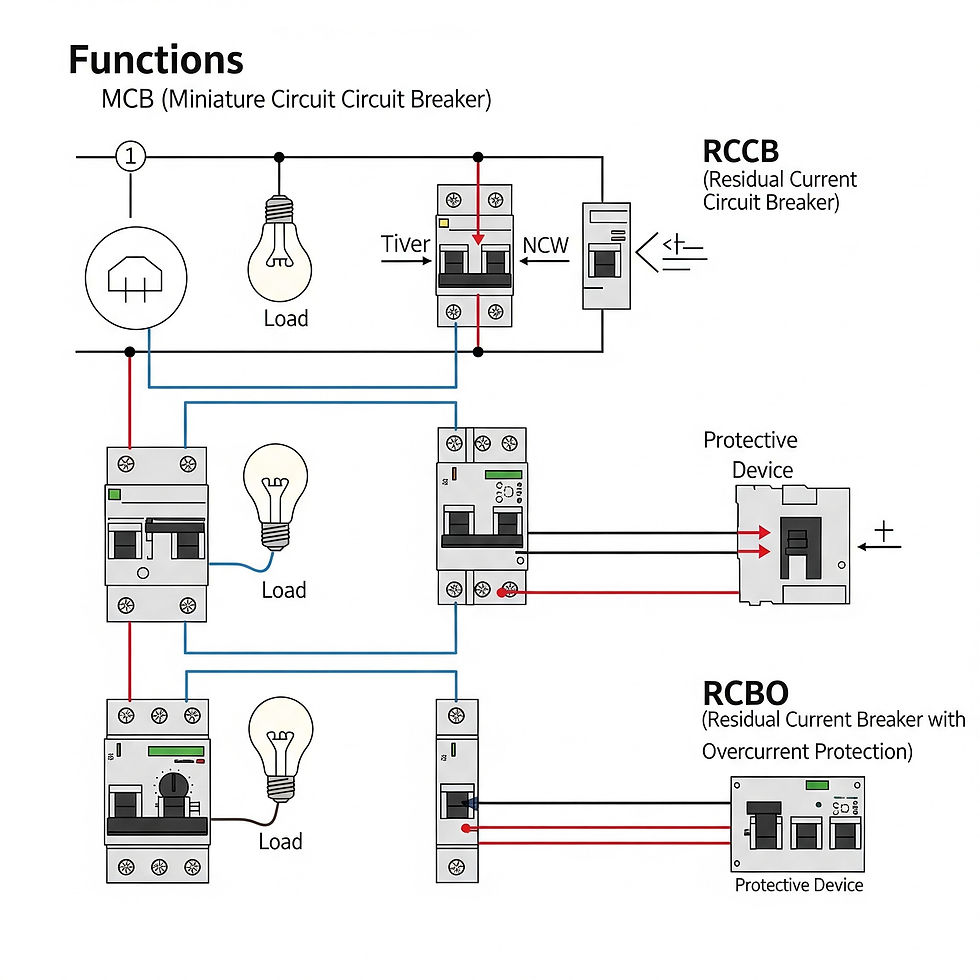
Pole configurations and current ratings.
What makes these devices different is also their physical form and electrical requirements:
MCB has the most flexible pole arrangements and come in single pole MCB, 2-pole MCB, three pole MCB, and 4 pole MCB arrangements.
This makes them adaptable to all types of circuits, including simple lighting circuits and three-phase systems. Their present ratings are usually 0.5A -125A.
RCCB are only available in configurations of 2 pole RCCB and 4-pole RCCB, since they have to check on the live and neutral conductors.
They have sensitivity ratings of 10mA, 30mA, 100mA, and 300mA; 30mA is the standard used in residential areas where the safety of humans is the priority.
RCBO normally come in two-pole and four-pole designs. Their present ratings are usually 6A to 63A, with leakage current sensitivities the same as those of RCCBs. They also provide breaking capacities of 4500A to 6000A, which provide stable protection under any fault condition.
The technical issues directly influence the consideration as a device to be used in the definite circuits, depending on the protection requirement and risks. Knowledge of these differences allows electricians to construct electric systems that provide the best protection with neither unwarranted complexity nor unwarranted cost.
When to Use Each Device: Real-World Scenarios.
To choose the appropriate protection device in each circuit one should be aware of where a particular one is best utilized in practical scenarios.
These differences between these devices are most evident and observed when the practical applications of these devices are considered in various settings.
Best use cases for MCB
MCBs perform well in situations where there are overloads and short-circuit conditions and where earth leakage is a non-issue. They are most commonly fitted in:
Homes where the risk is mostly that of circuit overload use general lighting circuits.
Refrigerator, heater, and fan residential appliance circuit breakers require overcurrent protection.
Business settings that incorporate Type C MCB in their lighting systems and HVAC units with greater power demands.
In the industry where Type D MCBs are used with high starting currents like conveyor belts and big motors.
Type B MCB respond rapidly to a 3-4 fold greater overload than normal, so they can be used in most cases of consumer application. Type A and Type Z MCBs are available in sensitive equipment like medical equipment or laboratory equipment.

Where RCCBs are essential
RCCBs would be essential in higher-risk risk of electric shock areas or in places where water and electricity may touch each other:
Water near the kitchens and the bathrooms pose a risk of leakages.
Swimming pools and hospitals are where electrical safety is the most important.
Circuits that need protection against sudden earth faults.
Locations that require more protection against electrocution or a fire outbreak.
RCCBs are designed to trip the moment they sense leakage, and as such, the risks of shocks, fires, and electrocutions are greatly minimized.
Contrary to MCBs, RCCBs ensure that humans are not exposed to the risk of being shocked by leakage currents, by sensing leakage currents as low as 30mA-sufficient to cause a potentially fatal electric shock.
Why RCBOs are ideal for critical circuits
RCBOs have the benefit of integrating MCB and RCCB capabilities, and are ideal in:
Single circuits driving water heaters and low-power consumption domestic applications.
Socket outlet circuits where human safety and equipment protection is needed.
Circuits in kitchen appliances and bathrooms that need special attention.
Electronics and computer systems sensitive in commerce.
To ensure that workers are not exposed to electric shocks and to prevent short circuits in the machines, manufacturing plants and assembly lines were to be constructed.
Important benefit RCBOs are selective, cutting off only one circuit affected and leaving the rest alive - limiting distraction and reducing troubleshooting complexity. They also save valuable space in the distribution boards since they use one device instead of two.
Common Mistakes and Safety Tips from Electricians
Serious errors during the installation of protection devices are common among master electricians. It is possible to avoid failures and safety risks in the system and identify them in advance. Not choosing the wrong devices.
· Selecting the wrong type of protection technology to use in a given application is the most common electrical safety error. Residential MCBs, when used in industry, cause frequent nuisance tripping.
Likewise, standard Type AC-RCBOs are usually selected because they will tend to make undesirable trips when used on electronic equipment circuits in which leakage current of pulsed DC is present.
· The other mistake that can be very dangerous is the wrong sizing - a small breaker trips often and disrupts the operations, a large breaker does not ensure any protection against overloads.
Most importantly, most electricians do not consider load characteristics, particularly inrush currents of motors and machinery, where a certain choice of trip curve is necessary.
Proper testing and maintenance routines
Periodic verification is a fundamental part of electrical safety management. Professionally suggest:
· Quarterly functional testing with built-in test buttons.
· Once a year performance check using test equipment.
· Assessment of physical damage, wear or deterioration.
· Making sure that connections are tight enough to avoid overheating.
In the case of circuit breakers with a current carrying capacity of more than 100A, it becomes highly crucial to set up the circuit breaker properly. At least one-third of adjustable circuit breakers are definitely left at factory settings and are not programmed to suit that particular application.
Conclusion
Learning about the distinction between MCBs, RCCBs, and RCBOs is what will decide whether or not your electrical system is safe and effective. The purpose of each device is different, and MCBs prevent any overcurrent cases, RCCBs prevent earth leakage, and RCBOs prevent all of these dangers.
FAQ
How can MCB, RCCB, and RCBO be distinguished from one another?
MCBs have the overcurrent protection and the short circuit protection; the RCCB has the electric shock protection caused by the leakage of the earth; the RCBO has the two-in-one device protection.
Which is better: RCBO or RCCB?
Critical circuits are also usually better suited to RCBOs, which provide overload and earth fault protection, compared to RCCBs, which only provide leakage current protection.
Why use RCBO instead of MCB?
RCBOs are also safer than MCBs as they not only provide overcurrent protection, but also earth fault protection.
Can RCCB be used at home?
Yes, RCCBs can be used in residential houses, particularly where additional electric shock safety is required as in bathrooms and kitchens.
Do these devices have special installation specifications?
The choice is made based on the load and location of installation and aspects such as appropriate wiring, earthing and breaker size are essential to safety.
Should I use RCD or RCBO?
RCBOs provide two protections (earth leakage and overcurrent) in relation to RCDs which only provide leakage protection and therefore RCBOs are more comprehensive than RCDs.
What kind of MCB is applied in houses?
Single-pole MCBs are often fitted to lighting and small circuits, whereas double- or triple-pole MCBs are often fitted to larger appliances and increased loads.
What is the combination of MCB and RCCB provided by an RCBO?
RCBOs are configured to protect against both overloads, short-circuit and earth leakage in a single device rather than use separate breakers to protect each operation.
Eleczo is e-commerce online store and one-stop all solution for all electrical appliance acquires the securitized electrical equipment. That is why we at Eleczo strive to offer perfect and reliable Low voltage switchgears MCCBs, which will cost the brands at affordable price. As the best Low voltage switchgears MCCBs supplier in India and across the global Eleczo deals in various electrical products such as light, fan, module cover plates, Digital Multi-meter and Clamp Meter, Industrial Cable, Surface Mounting Box, power sockets, miniature circuit breakers, Air Circuit Breakers, residual circuit breaker, Hotel Key Cards etc.
Each product is made with the highest quality material, improved safety, and follows all the safety protocols to get delivered to your house. We make Eleczo as a reliable MCCB dealer in India and global market that provides excellent quality and durability of products. Eleczo and its team have been leaning forward with one vision to offer the best products and product safety and security measures. Therefore, do not waste any more time and visit our website Eleczo.com and have the opportunity to view the gigantic collection of MCCB offered by various brands and ensure you get the appropriate one to fit your pockets. Visit the website Eleczo.com, Grab the best offer now. Backed By Mohan Exim - Authorized dealers and distributors of MCCB.


Comments